Avoiding the Startup Graveyard

Avoiding the Startup Graveyard
The fundamental difference between small and large companies: small companies focus on creating customer value (which accidentally creates shareholder value), while large companies focus on shareholder value (which accidentally destroys customer value).
A Question
What is the price threshold at which your company could no longer afford to field a sales team?
A Quote
"The single most important decision in evaluating a business is pricing power."
Warren Buffett
Big Idea #14: The Startup Graveyard
Source: SaaS Startup Strategy, Three SaaS Sales Models (2010), Joel York
Two problematic ingredients, low pricing combined with high-touch sales processes, create conditions that can seduce and ultimately destroy founders and their companies.
Theory
Why It Matters
Every company on the path to $1B in revenue must determine its customer acquisition strategy. The core question: Will the business model involve selling high-priced products to a small customer base or affordable products to many customers?
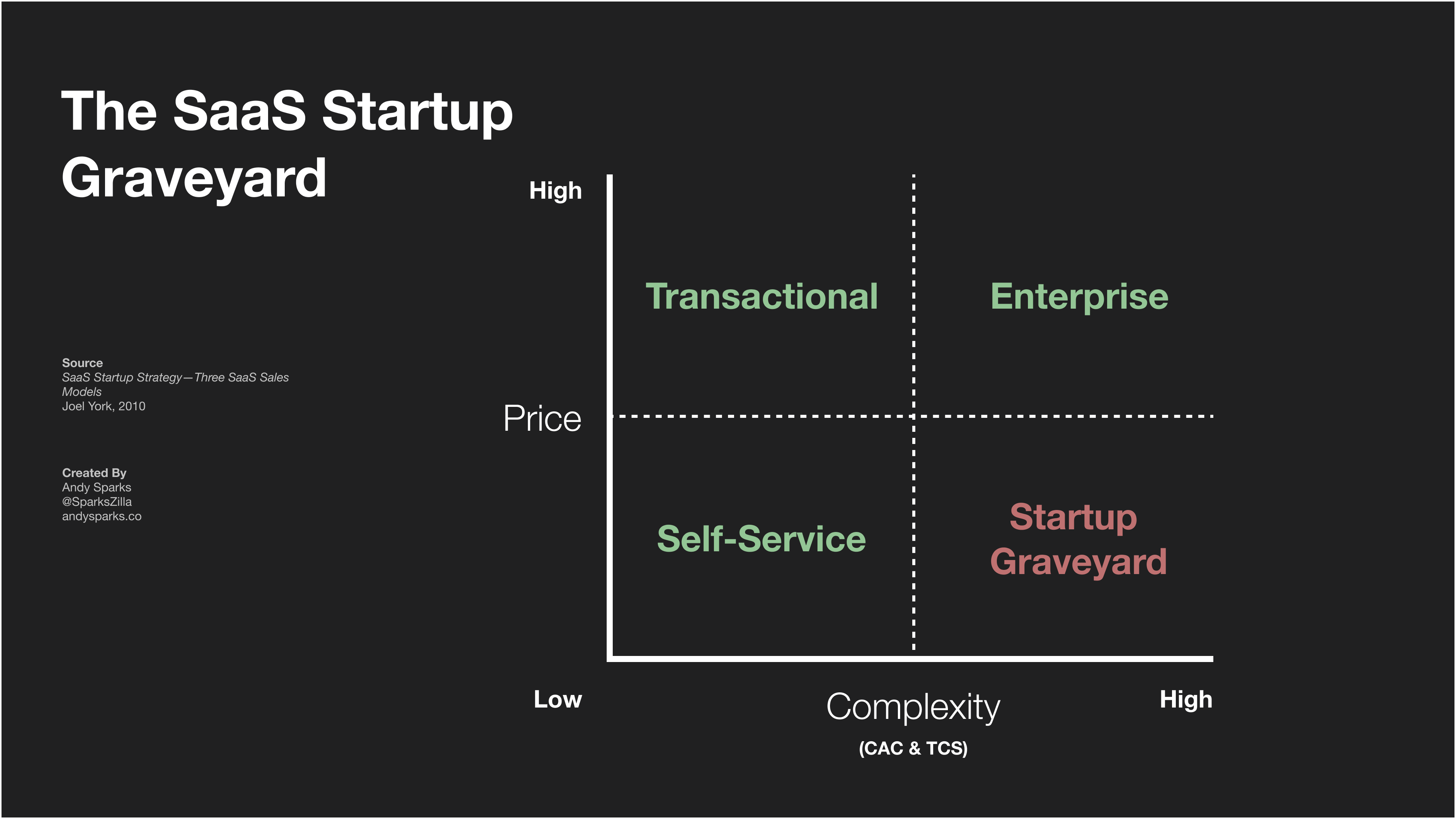
This decision determines which of three sales models to implement:
1. Enterprise Sales
- High-touch, multi-meeting sales cycles spanning months or years
- Expensive to execute, requiring premium pricing to justify sales costs
2. Transactional Sales
- Sales completed in 30 minutes to two meetings
- Straightforward, scriptable processes with minimal training
- Viable if sales yield exceeds 2 (fully loaded cost per rep divided by revenue generated)
3. Self-Service
- Required when price point becomes too low to support a sales team
- For example: a $1,000/year product would require a sales rep to close 150 deals monthly (assuming $150K fully-loaded cost) to achieve a sales yield of 2
- Success depends on clear website messaging and minimal human interaction
The Graveyard Trap
Companies often end up in the graveyard because founders conflate discovery with sales:
- During discovery, founders talk with potential customers about problems, gather feedback, and learn about willingness to pay
- This process resembles sales but has different objectives
- When founders discover they can sell at a low price point, they often ignore whether revenue covers costs, especially with venture capital funding
- Revenue grows initially, then plateaus when the company seeks additional funding
- Too late, founders realize their customer acquisition cost is unsustainable, they cannot raise capital, and lack resources to pivot toward self-service
Practice
The author shares Mattermark's experience as a cautionary tale:
Early subscriptions sold for $500/month or $4,799/year, with a fully-loaded sales cost of $200-300K per rep. Breaking even required closing 3.5-5.2 deals monthly; achieving traction required double that volume.
The CEO and author closed $1M+ in the first year, signaling readiness to scale the sales team. However, once hired salespeople were added, reps rarely closed more than five deals monthly.
The problem: Early-adopter sales had low complexity, but crossing the chasm increased deal complexity, causing sales yield to decline. Instead of recognizing this as a warning signal, the company blamed poor sales performance.
Recovery options, simplifying the sale, building self-service, raising prices, or adding features, came too late.
Recommendation
Avoid the graveyard by:
- Printing the 2x2 pricing/sales model matrix
- Posting it prominently in project management systems
- Reviewing it daily
- Committing to which viable quadrant the business will occupy
Reads & Resources
Articles
Leslie's Compass: A Framework For Go-To-Market Strategy
Mark Leslie's complementary framework examining the relationship between sales intensity and marketing intensity, with practical questions for evaluating product-market fit and go-to-market strategy.
From Twitter
It's a CEO or Co-Founder Job to Find PMF
Gokul Rajaram observed that Series B and C companies sometimes hire Chief Product Officers hoping they'll discover product-market fit, a misalignment of responsibility. A notable comment: "Any CPO capable of finding PMF for a series C company is better off starting their own company."
Audio
This episode explores pricing and value capture through the NFL's history. The hosts conclude the NFL may be among the few organizations that captures all, or exceeds, the value it creates.
Books

Don't Call it That
Eli Altman's workbook guides naming processes for new ventures and products. Altman's firm, A Hundred Monkeys, has created names including Dolby Atmos and Standard Deviant Brewing.
Dice Roll
A health-focused recommendation: This macronutrient tracking app offers intuitive design and helpful feedback for managing dietary goals and overall wellness.