1800's Wisdom: Three Components of a Business

1800's Wisdom: Three Components of a Business
American business has become a story of small heroes and scaled-up villains.
The Backstory
Two weeks ago, Pew Research published a study on public sentiment toward business in the United States.
- 80% of Americans said small businesses "have a positive effect on the way things are going in the country these days."
- When applied to technology companies, that number shrunk to 49%.
- For big business, the ratings were scathing: 71% of Americans felt "large corporations had a negative effect on the way things are going."
Why it Matters
As founders of startups, you may hope your business becomes a large corporation, but most likely you're not interested in 71% of Americans thinking your creation harms society.
The critical question is: what makes large corporations so problematic that small businesses avoid, and how can startups prevent transforming from hero into villain?
Andrew Ure's Three Systems of a Factory
When defining management or business simply, it communicates easily but loses inherent system complexity nuance.
Theory
Andrew Ure lived in Glasgow, Scotland, in the early 1800s. After earning degrees in chemistry and natural philosophy, Ure took a position at Anderson's Institution, a school founded to educate factory workers and managers. He taught and trained many owners and managers of major UK factories during the first half of the century.
A widespread early 1800s issue involved workers skipping work or stopping entirely, leaving proprietors with chaos. To address this, Ure argued factories needed three harmonious systems, compared to "the muscular, the nervous, and the sanguiferous systems of an animal":
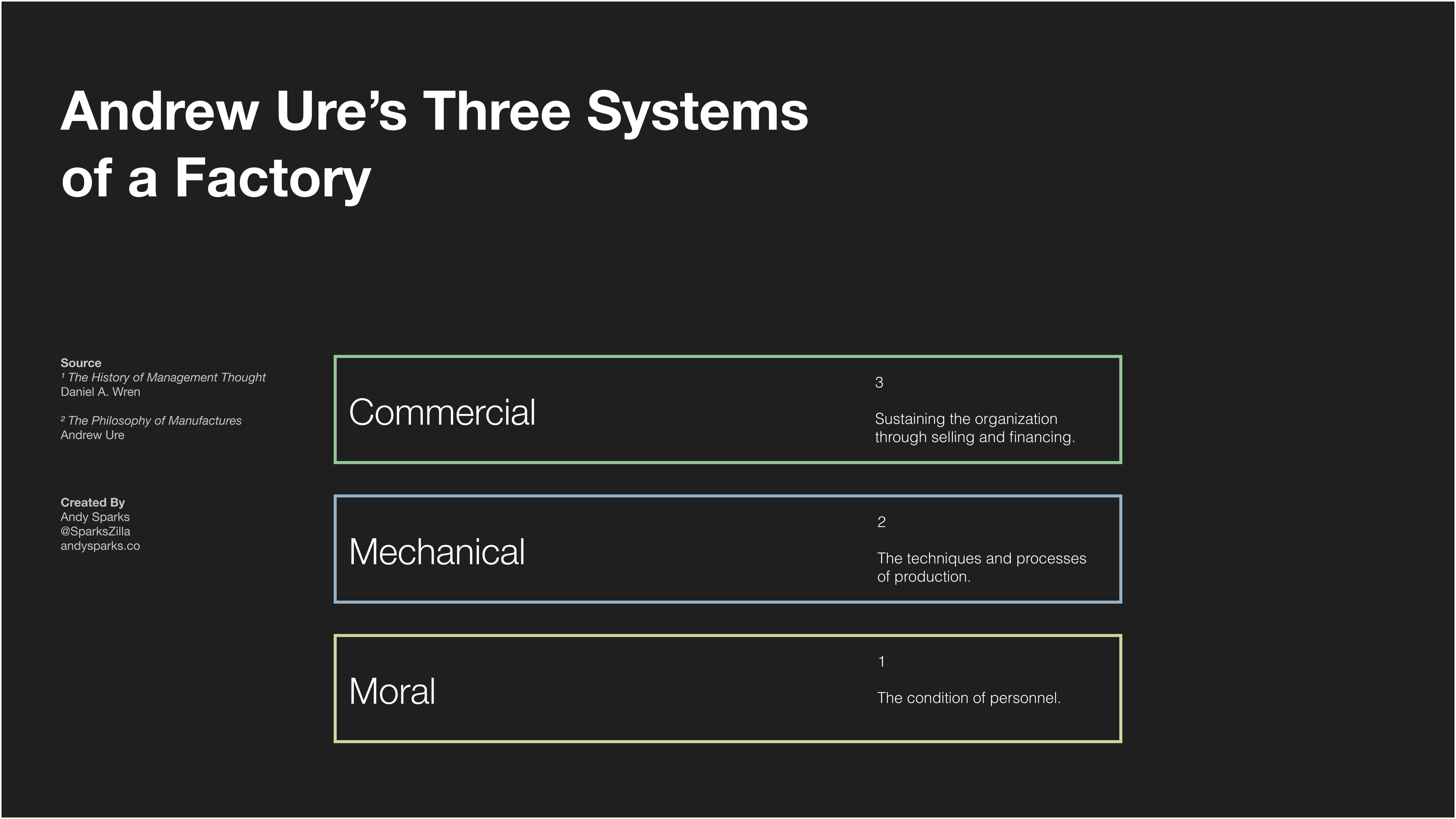
- The Moral System: "The condition of personnel."
- The Mechanical System: "The techniques and processes of production."
- The Commercial System: "Sustaining the organization through selling and financing."
Practice
Founders need to zoom in and out on their business, seeing both forest and weeds without getting lost. Models like Ure's help counter the human tendency toward unnecessary complexity.
Startups excel at assigning fancy titles and scheduling meetings more than solving the core issue. For example, pre-product-market-fit companies often have a CEO, VP of Product, Head of Engineering, Head of Sales, Head of Marketing, and numerous other positions without any actual strategy for reaching PMF.
Ure's system asks: (1) Does someone ensure we have the right people and they're satisfied? (2) Does someone own knowing what to build and how? (3) Does someone own selling and maintaining sufficient cash reserves?
The simplicity is compelling, though objections will arise about facilities, administration, marketing, analytics, and other unlisted functions. The counterargument: if individuals own each of Ure's systems, all other functions emerge naturally to achieve those goals.
In a 2017 piece, Brad Feld broke business into three "machines": (1) the product machine, (2) the customer machine, and (3) the company machine. Feld notes that sub-scale leadership teams (roughly 3 founders and 4 employees) allow a CEO to own one machine, but not more. Beyond roughly 20 employees, ideally one person owns each.
Reads & Resources
Articles
How We Get Hooked and Unhooked
Irritation, frustration, anger, anxiety, and fear are universal experiences. This piece explores Shenpa, a Tibetan concept describing the mental state triggered by unpleasant feelings that tempts us toward amplifying actions, like scratching a mosquito bite applied to life. The article provides practical tools for avoiding such patterns.
From Twitter
Regina Gerbeaux on Engineering Structures That Help Startups Move Insanely Fast
Regina, former COO at Mochary Method (led by Matt Mochary, author of The Great CEO Within), publishes practical guides as an executive coach to high-growth companies. Anyone would benefit from following her work, particularly Chiefs of Staff.
Audio
Dr. Wendy Suzuki on Boosting Attention & Memory
This Huberman Lab episode features Dr. Suzuki, a prominent memory researcher. A standout section covers four factors making information memorable: (1) novelty, (2) repetition, (3) association, and (4) emotional resonance.
Books
By Dave Hitz, co-founder and Founder Emeritus at NetApp (Fortune 500 for nearly a decade), this underrated business book particularly serves scaling founders. It shares practical, humorous stories about shifting roles as co-founder, building the business, handling challenges, and observing co-founder and CEO development.
Dice Roll
This isn't a performance review, it's year-end reflection practice. Steve Schlafman's template helps slow down, consider what happened, and envision next year. For mental clarity heading into 2023, download the template and complete his exercises during winter break.