Does Your Calendar Reflect Your Priorities?
Does Your Calendar Reflect Your Priorities?
This week Andy Sparks caught up with Paul Millerd, author of The Pathless Path and Boundless, to discuss "infovores," people who have an insatiable appetite for reading and learning.
Sparks identifies as an infovore himself, regularly pulling books from shelves during calls and clearing desk piles weekly. For founders scaling businesses, the challenge becomes different: there's too much to learn and not enough time. Rather than trying to consume everything personally, successful founders should leverage others' learning through coaches, newsletters, curated Twitter feeds, and peer CEO groups.
The Core Principle: Your Calendar Should Reflect Your Priorities
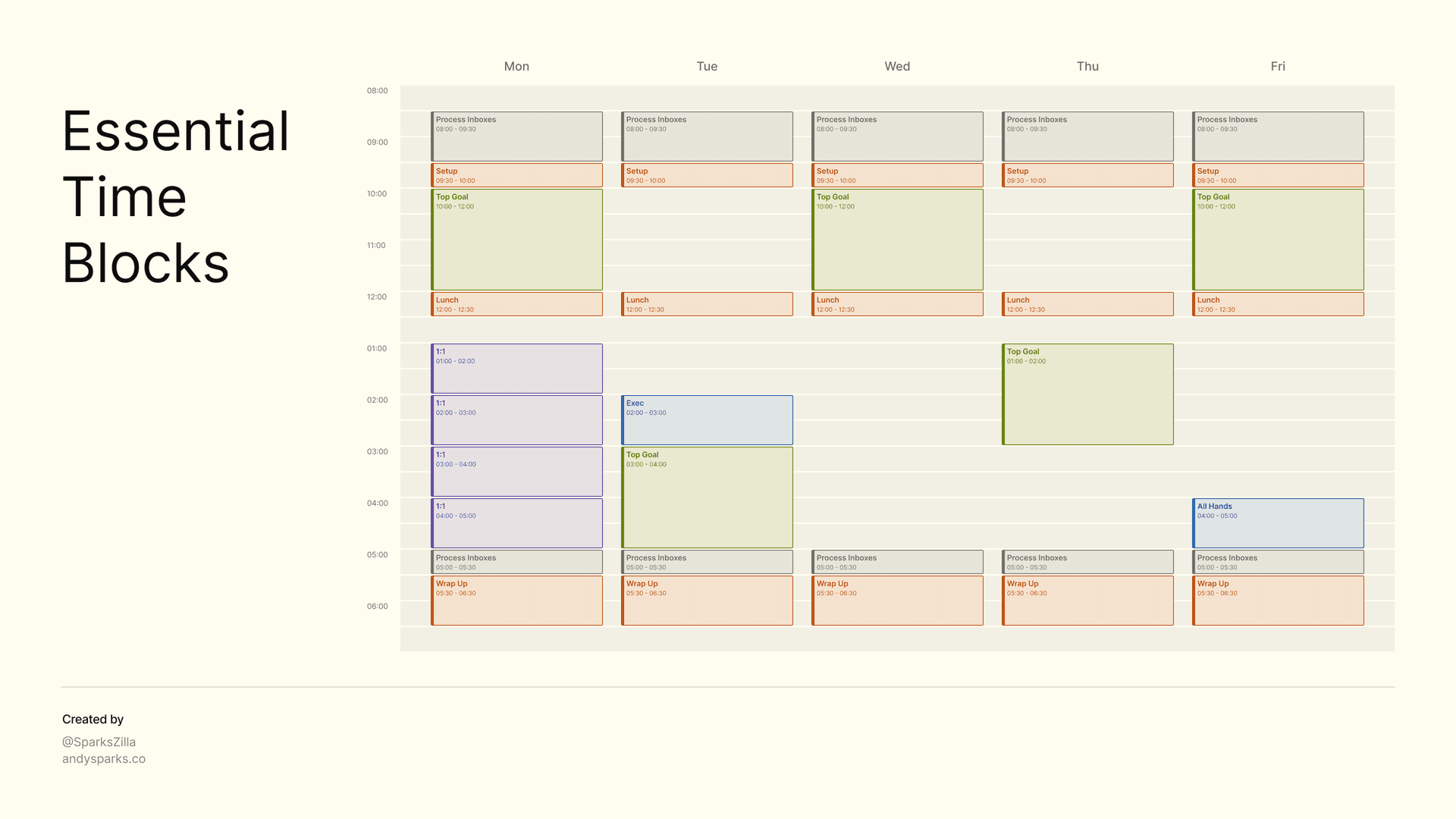
Years ago, Keith Rabois shared a principle that stuck with Sparks: your calendar should reflect your priorities. Most founder frustrations, slow hiring, misaligned team initiatives, stem from misaligned time management rather than strategy issues.
Theory vs. Practice
Theory: When founders struggle, Sparks asks them to identify their top three business priorities for the next 3-6 months. Their calendars typically reveal the disconnect: hiring might be listed as priority one but only receives minimal calendar time.
Practice: The application requires four steps:
- Identify your top three priorities and allocate rough percentages (e.g., 30% for hiring)
- Block meaningful time chunks for each priority
- Defend your calendar against distractions and meeting requests unaligned with priorities
- Audit weekly: track whether your actual time matches your stated allocation
"If your calendar regularly reflects your priorities (and the right priorities), you'll be happy with the results."
Reads & Resources
Articles
- "Standups Won't Save You" by Andy Johns offers alternatives to standard standups, focusing on action items and decisions
From Twitter
- Progress is non-linear; accepting ups and downs helps you ride momentum rather than fight it
Audio
- Seth Godin discusses finding your "smallest viable audience" when launching a business
Books
- On Being Nice from The School of Life explores balancing kindness with candor, offering: "A fundamental path to remaining calm and kind around people...is distinguishing between what someone does and what they meant to do"
Research
- Ethan Mollick's research shows meetings starting late are less productive and creative